Summer 2020 Southwest Biodynamic Group Newsletter
Updated: Apr 14
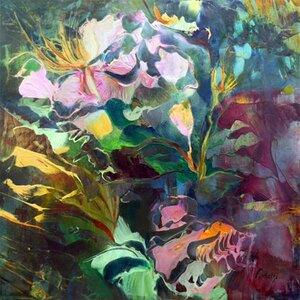
I know a bank where the wild thyme blows,
Where oxslips and the nodding violet grows,
Quite over-canopied with lucious woodbine,
With the sweet musk-roses and with eglantine:
There sleeps Titania sometime of the night,
Lulled in these flowers with dances and delights.
from ‘A Midsummer Night’s Dream’ by Shakespeare
Editorial
This newsletter is full of reports from local growers and gardeners. Usually, it is very hard to get reports, but I think the lockdown has meant when not tending their plants, people have been at their computers. Thank you to all the contributors.
I feel we cannot ignore current events – both the pandemic lockdown and the demonstrations for Black Lives Matter. I make no apologies for reprinting the statement from the British Biodynamic Association that we circulated by email previously. Our local core group endorses it wholeheartedly.
We have articles from Wendy Cook on the importance of food producers and awareness of how it is grown and produced and from Derek Lapworth a different view of the virus.
Derek has also written about seed collection – something which emerged from his response to the difficulty of obtaining seeds at the start of the lock down which coincided with main planting time.
For those receiving the print version of the newsletter you will also receive a sample of our new information card, designed by Melissa Milne. We will place them where those interested in good and nutritious food will see them.
- Diana White
Note from Treasurer
(Diana had just changed her hat!)
Thank you to all who have paid their annual subscription and apologies to those who sent cheques that have not been cashed yet. After several wasted trips to the post office with reduced days and hours of opening that kept changing I eventually manged to pay them in last week.
Those who still want to receive the newsletter and other benefit of membership but have overlooked payment, will receive one last electronic version.
If you wish to continue receiving the newsletter, please make your payment (see below) for it by the following means as soon as possible:
1) Direct bank transfer to Barclay’s Bank, Account No 13509680, sort code 20 60 88.
2) Send a cheque payable to S.W. Biodynamic Group to Diana White at
Flat 12 Apple Wharf, The Plains, Totnes, TQ9 5QL
For an individual or organisation is £15, A couple £20
Students & non-waged £10
For this you receive newsletters and preparations without cost from Jeremy Weiss at Velwell Orchard. Please phone 07962 432317 in advance.
Seasonal Gatherings
Until the ‘rules’ change we are unable to organise any gatherings.

Courage, Love and Meaning:
Tools for Resilience in the Here and Now.
Are we at a Turning Point in Time?
(The Coronavirus Situation)
Currently we need courage to face every day as we hear the news of an increasing significant death toll spreading around the Planet. This tends to be of the older members of the population. Courage to be prepared to participate in the act of ‘Suffering on behalf’ – a truly Easter Experience – and facing the possibility of huge changes on many levels for our society in due course. Time to stop and think, watch and listen – the polarity – the almost deafening sound of birdsong – is it the birds’ jubilation in not having to compete with the din of road traffic and overhead aeroplanes? The blossoms this spring also seem to express an exuberance that is almost theatrical. Steiner tells us ‘that the birds sing to help the flowers grow’. People are noticing his phenomena.
As an 80 year old living in the attic of a large detached house (occupied by other ‘retirees’) I am supposed to be self-isolating. This is quite challenging as I am a very social person and belong to several groups and do not have much literacy in technology. I have spent my life cooking and gardening and find it well-nigh impossible to only cook for myself. I am continuing to cook, albeit on a much smaller scale and smuggling out meals to friends who in return do shopping for me. This small service allows me to do something creative and of service.
I was born at the beginning of the last world war, a child of two rather cultured Mancunian parents forced to move to a horticultural area in a small village in Bedfordshire. The soil was good and I experienced the wisdom in being able to grow one’s own food, make one’s own clothes and Christmas presents, share with neighbours. Cooking was important – vegetables, we always had about five vegetables in any meal. I spent many summer holidays picking fruit on fruit farms.
This current crisis has shown up the weaknesses and lack of real resilience in what has developed in our food production and distribution.
The applause for our National Health workers, garbage collectors, postmen etc is well deserved but so far I have heard no acknowledgment of our farmers and horticulturalists. It is as if a real lack of consciousness has fallen over the question of ‘Where does our food come from, who grows it, who harvests it and who prepares it?’ Notice the anomaly of having to hire private planes to bring over Romanians (still capable of doing this important work) to harvest our Essex grown lettuces! That we depend too heavily on doctors and hospitals is a relatively recent development that science has all the ultimate answers and authority.
The current crisis shows how little we understand our own bodies and the vast invisible world of microbial activity; living in a society that seems to only deal with symptoms and not causes. Not fully understanding our own place in our intricately fashioned environment. We do not seem to realise that our spiritual consciousness co-evolved with our biological bodies and that the vastly important immune system continues to evolve with the evolution of our ‘I am’.
Thus we seem to have broken so many laws that no other creature would do – destroying its own means of survival. Our most life threatening illnesses have a ‘cold’ gesture where the body temperature drops, rather than hitherto illnesses have been accompanied by fever. The present pandemic attacks the middle realm, the lungs and by extension the heart – the whole feeling realm. The intellectual soul development has largely avoided the feeling realm but now we are seeing that important aspects of life that are repressed will resurface with gained energy! And human warmth is being expressed whilst other freedoms are dismantled.
Communities, schools and gathering closer, suppressed. No touching. This seems to perpetuate the phenomena of entropy – of fragmentation.
In my book ‘Foodwise’, I traced the various epochs of human nutrition linking them to an evolving consciousness (guided by Steiner and Dr Rudolf Hauschka’s wisdom). This long process brought the more insubstantial (etheric) human being (nomadic groups led by Shaman) characterised by the term ‘Milk and Honey’ through the agrarian ‘Bread and Wine’ to the present epoch (characterised by the Mineral) where mineral supplements are often taken. This has led to a hardening and coarsening of our ‘gravity laden bodies’. (This concept refers mainly to the Western trajectory of development)
We can experience separation, from environment, from each other, loneliness and isolation being emphasised by the current situation.
Easter and a very rare conjunction of planets involving Mars, Saturn, Jupiter and Pluto, has served as a backdrop to this crisis; a lack of real leadership which is currently giving much attention to the lack of PPE units, and the government’s mishandling of this issue No visible Parliament in London in this time of crises.
Now the world needs a new spiritual /physical road map. This so called pandemic has laid bare the paucity of perspective on the human/planetary project, but it also an opportunity to bring in a healing vision, one that answers the question ‘What are we doing here?’ This should link us to our roots in the past but with a clear orientation to the future.
A future which is capable of navigating a healthy relationship to technology but not being subsumed, dominated by AI, a path which can restore the dismembered sheaths of humanity and Nature. To address Parsifal’s unasked question ‘What Ails Thee?’ To join Osiris’ dismembered body by the feminine gift of healing.
In his book on this subject ‘Humanity’s Last Stand’, Nicanor Perlas has much good advice and early on in the book (p.5) he states:-
‘The way forward is dramatically demonstrated by Agriculture itself. The Medusa like torch of death of AI is THWARTED in Agriculture which will become a refuge for real humans not fake digital humans including their robotic versions. The development of human beings, if you look at Anthroposophical Cosmology, by evolutionary processes that recapitulate themselves in a different and more enhanced form at specific points in human history.
The food we eat and the agriculture we practice has been an important back story to this evolutionary process. However this recapitulation has stopped during our time. NOTHING IS BEING REPEATED now. This is because we have reached this point of HUMAN FREEDOM and it is unpredictable what humans will do with their freedom.
What human beings on this planet decide to do NOW will affect what happens in the epochs to come. The human being is now becoming a powerful agent of transformation. But we need to drop our masks which separate us from the unity of world consciousness, form alliances with other global identities’.
‘If we allow things to take their own course in the manner in which they have taken their course under the influence of the world conception which has arisen in the 19th and early 20th centuries – MATERIALISM, we shall face the ‘War of all against all’ towards the end of the 20th Century. We would see the gradual development of a type of humanity devoid of every kind of social instinct which would talk all the more of ‘social questions’. ‘(Rudolf Steiner lecture: The Remedy for our Socially Diseased Civilisation, Dornach 6 Aug 1921)
Now the quest is finding the purpose in our Higher Selves that understands, cares for and loves the PROFOUND INTENTIONS embedded in the whole fabric and evolutionary thrust of the Universe.
- Nicanor Perlas, ‘Humanity’s last stand.’
‘If we take the 24 hours of a digital clock, we can say that for 23 hours and 50 minutes, humanity was deeply and overtly spiritual. In the last 10 minutes, humanity became more and more infected with materialism that acted like a highly virulent virus spanning the planet’.
‘Will you WAKE for PITY’S SAKE?’
‘Sleep of Prisoners’, Christopher Fry
Viruses and Weeds as a Path for Regeneration
This article is a precis, written in my own style, of a remarkable video of an interview with Dr Zack Bush MD. It is available by searching for: ‘Doctor who predicted Covid-19 answers all’ and his name.
His main thesis is that whenever we have an imbalance in the ecology of nature or in the microbiome of ourselves, it invites or even necessitates endemic problems. For instance, tuberculosis occurred during the industrial revolution because we became divorced from the balance or harmony of nature, so this points to the close connection between our whole environment and our own pathology.
Viruses and the Environment
The Covid-19 virus is unmasking the toxicity of our environment. ‘Nature is a toxic stew of dying soils – the use of glycophosphate or Round-up in the intensive farming area of China has unmasked the relationship of cyanide to haemoglobin and is this an adaptive event happening as nature has exuded this toxicity’.
‘The virus itself is not enough to cause the deaths; we need the perfect storm of air pollution etc’.
You may recall that a few weeks ago, the recorded deaths from Covid-19 in China went down to zero – Zack points out that this was mainly due to the much improved air quality during the very strict lockdown.
Similarity of Viruses and Weeds
Have you noticed that when you rotovate an area, weeds will emerge that weren’t evident when the biodiversity was in place.
‘The weeds are not the problem, they are part of the solution in regenerative agriculture and part of nature’s way of regenerating the eco-system – so the weeds have these important early niches in reforming the network of mycelium and the intelligences within the soil that can then rebuild the micro eco-system for the bacteria and fungi and ultimately the seedlings and the biodiversity can come back out of the seed bank that is deep in the soil and express itself again’.
So the weeds are never the problem, they are the symptom of the collapse of biodiversity.
Viruses
Zack is deeply impressed by the extraordinary beauty of life and includes viruses in this view. ‘Life is adaptive and regenerative and is always looking for the next solution and the way we look for solutions and adaptability is through viruses. If we damn viruses we damn the language of life itself.' But he goes on to say that the mainstream is now making this into a war against the microbiome. The problem has not been HIV or now Covid-19, the problem is that we have destroyed the microbial biodiversity. This is why there has been an increase in children’s diseases from 1.2% chronic disease in the 1960s to the most recent Medicaid screen of 52% of children with chronic disorders or diseases.
The damning indictment upon our society is that in reality it is many of the farmers and doctors who unknowingly have been taught to kill.
If you kill the weeds you need more herbicides and more chemical inputs to maintain plant growth and if you give children a whole stream of vaccinations, you weaken the general immunity and therefore health of children. (However, doctors are somewhat forced into this situation and I have no wish to make judgements here – note by Derek).
The last minutes of this video are exceptional and I have never seen so many comments from people. Very heartening to hear and a very different take on the situation.
- Derek Lapworth
Seed Saving and Food Shortages
The exchange of seeds which I organised this year proved quite successful with over 20 people calling round to collect seeds. I am quite happy to continue this service for the time being but hopefully a more concerted approach will emerge.
Considering the worst case scenario, if there is widespread economic collapse and social chaos, this would lead to serious food shortages. To alleviate hardship, it will be helpful to support local growers and farmers and for people with large gardens or land, to consider converting more area to growing potential.
However, further down the line, the saving of seed and especially biodynamic seed could become of paramount importance. There is certainly no guarantee that seed companies will be able to operate to supply all the need. Also, the localising of varieties is very important, some varieties may suit a particular area or region and the saving of seed develops an extra meaning to our work and completes the cycle from seed germination to seed saving.
In order to do this successfully, we need to work as a group. It would help if each grower were to work out their NEED for next year, how much seed would you need of which varieties. Then a meeting could take place to discuss sharing of seed, methods of saving and general support.
Frankie van der Stok will be available to support the methodologies required and until someone comes forward to organise this work, please liaise with me.
- Derek Lapworth 01364 644010
Vital Seeds at Foxhole, Dartington
In 2018, Fred Groom (who used to live at Embercombe) and Ronja Schlumberger founded vital Seeds in response to the lack of availability of UK-grown organic and open pollinated seed. They will soon be offering an online introductory course on seed saving and related aspects. To register an interest, just go to their website www.vitalseeds.co.uk.
News from Growers and Gardens
East Moore Orchard
Hazard, Harberton, nr. Totnes, TQ9 7PE
It has been another strange Spring, cold and wet and then cold and dry! Just a few weeks ago, things really started growing, and we have been working on ways to keep our crops watered. We’re very grateful for the bore hole we had dug last year which has given us more confidence in our water supply.
Through the seed swap initiative we were very grateful to get some tomato seedlings from Anne Marie Stibbe which have supplemented the self -sown seedlings coming up from last year and are beginning to flower.
Currently we are harvesting salad and rhubarb, with broad beans coming along. Later in the year we hope to have French beans, courgettes and soft fruit coming, and what looks like a good apple harvest.
We feel ourselves very lucky to be working the land in lockdown and enjoying the beauty of this Spring even more than usual. It feels sad not to be able to share it with others, as our camping activities are on hold, but this has given us the opportunity to encourage the wild flowers to set seed in our camping area.
We acquired some new hens in April, and they surprised us by roosting in one of our apple trees. The weather has no doubt encouraged them, but so far they are keeping it up every night. So lovely to see them doing what comes naturally! We have also been enjoying our bird visitors, with Swallows back for the first time in many years.
- Noni McKenzie
Half Moon Field
outside Totnes on road to Rattery
Things are flourishing and in good order at Half Moon field. The polytunnel has come into its own, its first full year up. The natural abundance of nature is A Wondrous Thing!
We have lots of red corn and squash and plenty of veg, The ducks are keeping the vegetable garden slug free and entertaining us and we are delivering excess chicken eggs and veg to a small group of the local community.
The owls in the barn have reared young again. The wildflower Meadow area is blooming.
- Carol Asuray
On the Hill
Oxen Park Farm, Lower Ashton, Exeter, EX6 7QW
Three years ago Tina and I had the good fortune to be able to buy Oxen park farm a 55-acre holding nestled in the Teign valley. The farm had been home to Jerry and Rosemary Horsman and their sucking heard of South Devon cattle for the previous 24 years. Jerry still keeps a very small family of his cattle on the land and at the age of 83 still pops down daily to check them.
As a logical continuation to the land-based educational work that I developed whist teaching gardening at the South Devon Steiner school and 10 years at Embercombe we have established On the hill, an experiential learning social enterprise hosted here at the farm. We have planted a four-acre apple orchard and we are continuing to bring more of this fertile land under cultivation for vegetable production. From the onset, we have been asking ourselves how can this land be used to best serve the needs of the wildlife, people and the future. Our mission for On the hill is to 'engage people in meaningful activity in service to the land, community, the self, and the future.
In these times when clearly this year there will be no groups of excited children and teenagers coming our way, we are just focussing on the growing of food. our vision is to set up a new entity hosted by the farm that will be a Community-supported agriculture initiative operating as a separate entity proving around 100 veg boxes all year round to customers in the vicinity.
It appears that one positive outcome of this virus is that people are realizing the value of obtaining their sustenance from their own locality. Our aim is to develop both not for profit social enterprises at the farm with the message to people in general, 'get on my land!!
We are in conversion to biodynamic and we are part of an extensive mid-tier stewardship scheme planting many trees and rewilding areas of the land whilst maintaining the health of the grazing land with our flock of Shetland sheep and the South Devon cows.
I am very excited about what will now be a massive movement of regenerative agriculture. Biodynamics has never been more relevant. We very much look forward to inviting you all here for a stirring, social and farm tour when this is all over.
In the meantime, please keep in touch via Facebook and the website www.onthehill.camp

Tom Dickens - trainee 
Jo Clarke, late evening tractor therapy
Sweet Sigford
Here is a link to a video sent and made by Gordon Clarke showing how to make a ram pump for his irrigation system to his polytunnel at his land at Higher Sigford, Newton Abbot...
From the walled garden at Buckyette, Littlehempston.
Along with a huge amount of bramble clearing and digging of tough tangled roots there have been some wonderful discoveries here in the walled garden at Buckyette, such as the rich organic matter built up under 20 years’ worth of brambles and which I am now using as a growing medium for young plants, the old rhubarb plant which once uncovered, burst into life and sent up a giant flower spike about a 1m tall, even the way the garden is perfectly positioned to make optimum use of the early morning sunshine, there’s also an ancient apple tree at the centre which although mostly rotten at its core still produces heaps of apples.
Recently I enjoyed stirrings of the ‘cow horn manure’ and ‘silica’ preparations along with Barbara and Diana, both long term dwellers of Buckyette and keen enthusiasts of Biodynamics. The three of us sat quietly (socially distanced of course) once in the evening for the Cow Horn and then first thing the next morning for the Silica. These were my first stirrings in the garden. The occasion felt profound, like the three of us were tapping into the soul of the place.
Part of my aim in taking on this garden is to explore working with biodynamic and permaculture principles in a complimentary way. This is a theme I’m exploring through a permaculture diploma which I started in the winter, with Marina O’Connell of the Apricot centre as my tutor. Relatively new to both Biodynamics and Permaculture I am enjoying this process of discovery and observations of the three fold head, heart and hands of my interactions with this beautiful and ancient place.
- Melissa Milne


Velwell Orchard
Velwell Orchard is closed to volunteers and visitors at the moment, but Jeremy and family are working hard growing lovely fruit and vegetables. Please see their website for up to date news.
Apricot Centre, Huxhams Cross
Again, the Apricot Centre is closed to visitors and volunteers, so the team is working extra hard, as there is hugely increased demand for their bags and boxes,of biodynamic vegetables, eggs, flour delivered weekly. For up to date news please see their website www.apricotcentre.co.uk
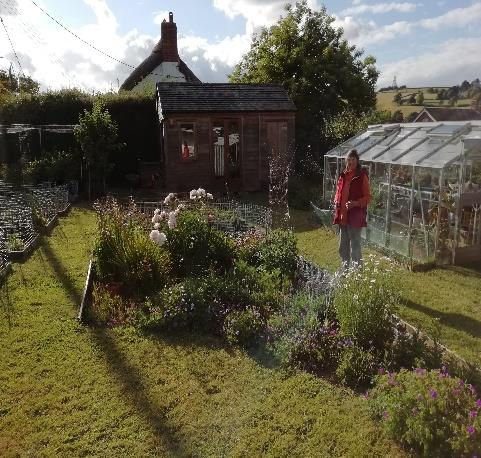
Val Collett’s quarter acre garden in a village outside Exeter
For centuries this had been farm-hands’ gardens before Val came to it ten years ago. On a windy sunny ridge, it is defined by ancient hedges with a few huge trees nearby. The first task was to get the Biodynamic compost heap going, then digging the beds for flowers, fruit and vegetables and sowing seeds in the greenhouse, plus spraying with Preparation 500 and 501 supplied from Velwell Orchard.
The intention was to provide some Biodynamic food for the family, together with enjoyment of all aspects of plant life, bird and insect life, even the moles and chickens. So what have we now?
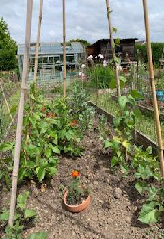
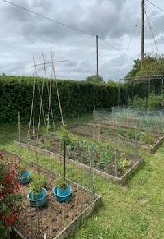
Eight raised vegetable beds enabling 4-year crop rotation. In summer they are fenced in to keep our few free-ranging chickens from damaging the veggies, but in winter the wire fences are removed for the chickens to take care of the soil.
A fruit cage shelters soft fruit, next to a productive apple tree. A lawn gives much pleasure and loads of useful grass cuttings. Beautiful beds of flowers, ornamental bushes and healthy hedges accommodate bees, birds, and many insects.
Dwarf French marigolds really keep the blackfly away!!!
Several seats for others to enjoy fresh air, lovely skies, the beauty and life of the garden.
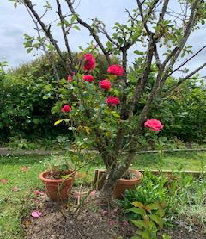
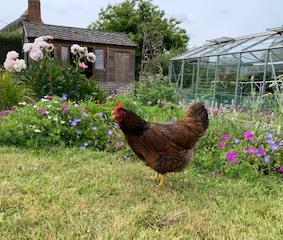

My main yearly problem is finding cow manure for the compost heap; the thriving comfrey and nettle beds plus BD Compost Preps are very helpful but not sufficient without the manure.
This year my declining health led me to plan and guide helping hands of others rather than be the main lifter and bender. However, sitting and sensing what is needed next has hugely increased my awareness of the unseen forces which ray into a garden already enlivened with sensitively formed compost, the BD Preps, plus companion planting where suitable. I sense the powerful forces from beyond Planet Earth as they stream into the lovingly tended soil, the young plants reaching upward, the flowering, fruiting and seeding as the plants go about their business.
My own ailing body also receives these forces. I am sure the BD garden is keeping me alive and delighted to be so.
- Val Collett
Promoting Social Justice, Equity and Inclusion
(A statement from the British Biodynamic Association)
As an organisation, the Biodynamic Association is committed to renewing the health and wholeness of our communities through biodynamic agriculture.
Distressing recent events, highlighting yet again the deep racial inequalities in our world, have been a painful reminder for us in the UK Biodynamic Association of the need to move forward and progress much faster, and, along with the whole farming community, to commit and achieve greater diversity in every way possible for our farming, food and gardening movements.
We recognise that there are significant barriers in the UK to all those from disadvantaged backgrounds entering the agricultural sector, including access to land and capital resources. Barriers also exist to accessing healthy and nutritious foods that should be everyone’s right.
These are areas that we are working to address, and in doing so committing ourselves to more fully listen, learn, and promote social justice, equity, and inclusion. Through positive action we join the global biodynamic community to make positive change. Just as it was true in Rudolf Steiner’s day, the urgent need for social healing is intimately connected to our relationships with food, land, and spirit.
May our feeling penetrate
into the centre of our heart,
and seek, in love, to unite itself
with the human beings seeking the same goal,
with the spirit beings who — bearing grace,
strengthening us from realms of light
and illuminating our love —
are gazing down upon
our earnest, heartfelt striving.
~ Rudolf Steiner, 1923
Southwest Biodynamic Group
The South Devon Biodynamic Group’s purpose is to inform those interested in biodynamic (BD) methods of gardening and farming of what is happening in the area. As a member you receive:
Quarterly newsletters and seasonal gatherings where we make the biodynamic preparations. These are then made available to members free of charge.
A library of Biodynamic books kept at The Apricot Centre.
We charge an annual subscription of £15 per person and £20 for a couple. We offer a concession of £10 a year if needed.
Preparations are available from Velwell Orchard.
Please contact Jeremy Weiss 07962 432317, velwellorchard@yahoo.co.uk
If you wish to join, please contact Diana White (Treasurer) at dianawhite35@hotmail.com or phone 01803 473551


Comments