Spring 2021 Southwest Biodynamic Group Newsletter

Spring
Nothing is so beautiful as Spring –
When weeds, in wheels, shoot long and lovely and lush;
Thrush’s eggs look little low heavens, and thrush
Through the echoing timber does so rinse and wring
The ear, it strikes like lightnings to hear him sing;
The glassy peartree leaves and blooms, they brush
The descending blue; that blue is all in a rush
With richness; the racing lambs too have fair their fling.
What is all this juice and all this joy?
A strain of the earth’s sweet being in the beginning
In Eden garden. – Have, get, before it cloy,
Before it cloud, Christ, lord, and sour with sinning,
Innocent mind and Mayday in girl and boy,
Most, O maid’s child, thy choice and worthy the winning.
By Gerard Manley Hopkins
Editorial
The South West Biodynamic Group made grants to three people towards the cost of ‘attend’ the online Biodynamic Conference - Breathing with the Climate Crisis – ecologically – socially – spiritually. This was organised by the Agriculture and Youth Section at the Goetheanum and tackled the pressing issues of our time.
The only stipulation we make if a grant is made is that the recipient brings back something of what they learn to inform the other members. The bulk of this newsletter is given over to articles by Wendy Cook and Kit Buckley. Naturally some of the content overlaps but each author have a different emphasis on what they share with us. But first news from Local BD growers and producers -
Spring News
from the Apricot Centre and Huxham Cross Farm
On the farm, as we approach the middle of March and the spring equinox is nearly upon us, we are beginning to sense the subtle seasonal shift and the joy, energy and new life that spring brings. As the tree sap is rising- slowly transporting sugars through the trunk to prepare the tree for leaf- we are busy gently tapping Silver Birch and Maple to sustainably harvest this clear, slightly sweet sap from a local wood. Throughout March and possibly into the first week of April (nature depending) we will be bottling and selling this very popular sap at our market stall in Totnes on Fridays.
Our winter pruning of apples and pears is underway and the trainees have been developing their knowledge of fruiting tree management and practical pruning skills. We have been busy developing our soft fruit area, including a new plum orchard (variety -Opel) of fifty trees and planting several rows of summer and autumn fruiting raspberries, gooseberries, strawberries, blackberries and rhubarb- which should start cropping in 2022. Our annual seed sowing has begun and will continue through until August. Our growing team has been carefully managing the crops to prepare for the hungry gap so we can continue to provide our customers with local, biodynamic and organic produce. We are experimenting with overwintering mangetout, are exploring growing three varieties of sprouting broccoli (Mendocino, Burbank and Claret) which will flower at slightly staggered times and have been planting early beetroot, spinach and salad in our tunnels. We are currently exploring the possibility of collaborating with a local beekeeper to provide space for an apiary in Far Week.
One of our team members, Rachel, has been busy over the winter months undertaking an extensive and insightful research project with the support of funding from the Devon Environmental Fund. The report aims to assess several impacts of The Apricot Centre over the last five years, including carbon footprint, biodiversity, economic viability, nutritional analysis and social impact. This project has provided valuable data for the farm and support for the biodynamic and regenerative agriculture we practise. Using the farm carbon toolkit, we are sequestering three times as much carbon as we are emitting and our soil organic matter has increased by 38% since 2015. We have just begun working with the BioNutrient Food Association to begin analysing the nutrient density of our fruit and vegetables and have signed up to be a Griffin's Grower Partners to support the development of a Bionutrient meter. As the year rolls on and lockdown eases we hope to be holding farm walks and seminars with the aim of encouraging and supporting other farmers to convert to regenerative agriculture. The full report will be completed in April 2021.
Our local mill project 'Reclaim the Grain' is in full swing and our newly designed flour bags are out on the shelves. Reclaim the Grain aims to provide locally grown and milled, biodynamic and organic flour. Our knowledge and experience of growing and processing grain is constantly expanding and we have recently reduced the price of our flour as we developed a greater understanding of the operational procedures involved. We have also been busy processing our farm grown organic, biodynamic dried beans. As most pulses are imported, by supplying British pulses we are trying to provide the opportunity for a local, sustainable vegetarian or vegan diet. Back in the summer we grew White, Brown, Borlotti and Ying Yang varieties which are currently being threshed, sorted and bagged to be sold at our Totnes market stall.
The farm recently collected seventy-five new chickens to add to our flock to meet our egg demand. Fifty of our older hens have been retired to local homes as they still have some laying years ahead of them. Our resident cows, Daffodil and Damson, have been enjoying some of the wet winter months in their new shed at the back of the barn. They have been steadily munching through our organic-biodynamic hay supply that we harvested last August and have been creating a wonderful manure mix that will be used on the land next year.
Wellbeing on the farm: The wellbeing service has seen an increase in the referrals for our outdoor nature connection workshops, we have run covid safe sessions for young people and have bookings for our Easter sessions at the Farm. It has felt really good to be out in nature again and working with her to benefit our wellbeing and mental health.
We have also started to book our Veteran sessions with Farm Able again which means that our project for the woodland area can continue!
The Wellbeing Therapeutic Service has continued to be busy and we are looking forward to welcoming our wonderful youtube people back on to the site, although working virtually has been amazing to be able to continue so much of the work that we do there is nothing quite like being able to look out over the farm vista during a face to face therapeutic session. It just makes us all feel good!
Training at The Apricot Centre. Much like the rest of the country we decided to cancel many of our training courses over covid, we didn’t want to move them online as we felt much of the appeal of the courses was that they not only provide theoretical knowledge but also authentic real hands on experiences for the practical elements, there is nothing quote like sprinkly preparation 501 on the land whilst it is blowing a hoolie and raining horizontally!
That being said we have just started to offer our face to face courses again and although we are running under strict Covid guidelines with greatly reduced numbers it has been a pleasure to start to share our knowledge again.
If you are interested in learning more about what we are up to and booking on you our courses please visit our website www.apricotcentre.co.uk
- Written by Stephanie Quirk (Farm Trainee) and Rachel Phillips
News from Velwell Orchard
Please look at the news section of Website Velwellorchard.org for a recent update, volunteering opportunities, courses and plans for the future.
News from Hapstead Farm
Volunteer Opportunity. At Hapstead Farm we are running a farm club for children this summer term, and are looking for a volunteer to assist on Friday afternoon and Saturday each week during term time. The work will involve facilitating experiential learning in animal husbandry, horticulture, and farm related crafts and building projects. This may well become a paid position. If you are interested please email Tobias Goulden, tobiasgoulden@yahoo.co.uk.
Help Needed – Daniel and Mary Sutherland have asked if there is anyone with spare time able to help with their beautiful garden at Craxon Combe, Diptford, TQ9 7NA. Please phone 01548-821379
Breathing with the Climate Crisis
ecologically – socially - spiritually
Report of Digital Conference, 11th February to 14th February 2021
– by Kit Buckley
Hosted by the Agriculture Section and the Youth Section at the Goetheanum, Switzerland, this Conference was inspiring, memorable and very timely. The leaders of the two Sections, Ueli Hurter and Constanza Kaliks, asked these basic questions.
How can we breathe in the climate crisis?
How can we understand the climate crisis at an ecological, spiritual and social level?
Can the Earth actually still bear my footprint?
Climate change is happening – it is seen in the most varied places. Each person can inwardly balance the existential uncertainty that this causes to a certain extent, and nature and agriculture also have certain powers of resilience. But is there not an ongoing erosion over the years, both in the inner and outer fabric? It was proposed to use a broader concept of climate in developing the view of the earth as a living being, and examine the facts and discuss possible solutions; explore the purpose of the individual in relation to an apparently hopeless situation for humankind; confront the explosive social consequences with the potential of a common will to tackle the urgent tasks together.
The wish was to reach an enlivening breath which would allow us to say “The Earth is waiting for my footprint – I want to walk on the earth and make my contribution for our joint future”.
These deep questions framed the Conference; background evidence and explanations of our dire current state of affairs were given, but there were many more expressions of hope and examples of where we have the power to change; how we can indeed breathe with the being of the earth and not act against it. With the breath we are connected to the cosmos and with love for the earth, connecting with the heart, can we then solve crises.
New ways of working with the crisis and subsequent action are needed from us. But there are solutions. There is hope. A common theme was first the need to recognise that the system has been broken; then with a big effort breaks can be healed; to heal the breakdown the mechanical way of thinking and feeling needs to be changed to living thinking. Our current state of affairs with the changing climate is a wake-up call to the human being to transform ourselves, to take care of the earth, not for any commercial gain, but for the sake of the planet itself from whence we come.
“From Climate Change to Climate Collapse”
- keynote talk by Hans-Ulrich Schmutz
For me this lecture provided the ground for the rest of the Conference. He said that to shape the future we need to know and appreciate the past, and proceeded to build up proof of the ice age cycle and other cycles over the millennia.
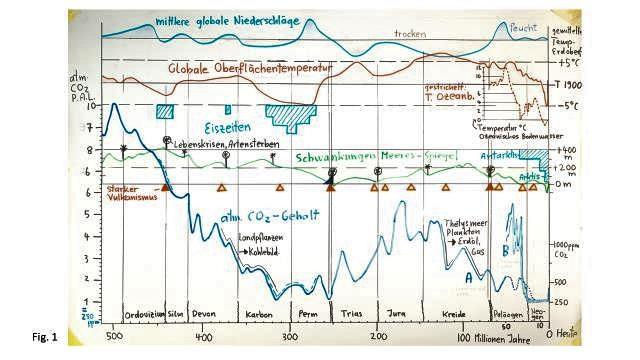
With a wonderful hand-drawn and illustrated chart he showed irrefutable evidence of how human activity of extracting and burning fossil fuels since the Industrial Revolution has suddenly in the last 150 years broken these cosmic rhythms. His hand-drawn charts (made 30 years ago!) gave a more sensory, heartfelt understanding of the somewhat technical data in contrast to computer generated graphs.
(We are very grateful to have had permission from Herr Schmutz to use his drawings).

The programme over the three and a half days consisted of Keynote Talks, the Michael Letter, Future Labs, Networking opportunities (there were 1083 participants worldwide). There was a section with extra reports from around the world, moderated discussion offered by individuals, opportunities for eurythmy exercises and more. A wonderful film from Waltham Place in the UK where Andre Tranquilini (Formerly gardening teacher at the Sout Devon Steiner School) is now had been made especially for the Conference.
I found the online format of the Conference surprisingly alive and any doubts I may have had disappeared with the first of three start-of-the day renderings of the Michael Letter, (Anthroposophical Leading Thoughts Chapter “From Nature to Sub-Nature” 183-185, GA 26) by Petra Derkzen, a Dutch biodynamic farmer, together with two musicians Jacob Bergsma and Johanna Lamprecht.
This text deals with a key question of how we can find a relationship to technology and materialism without becoming unfree. The sub-earthly, mechanistic forces need to be recognised today – the spirit is absent – Ahriman is present. Passages of the Letter were read by Petra and were related to her own experiences. She said a text is a seed to take into the warmth of the mind. The passages were enfolded in vocal and musical offerings including movement and voice exercises where one could participate in heart-felt experience, emphasising that even as we think with the head, it is the heart that feels, that knows something to be light or dark. Ahriman may be present, and he does watch us, but only from the head. He has no understanding of feeling; nor the meaning of music. Petra asked “How do you know something to be true? Maybe you are in a deep fake! What is your anchor point?” She said the challenge of presenting the Letter electronically had been liberating. The challenge is to be aware what technology does to us without fear; the need to be aware so as not to slide down with it. She spoke of the powerful secret of the rhythm of the world that lives between the breath and the heart. With the breath we are connected to the cosmos, with love for the earth.
Social Questions and Biodynamics.
The Future Lab I had chosen dealt with how those practicing biodynamics can work with social questions and situations in relationship to the three aspects of the social, rights and economic life brought by Rudolf Steiner, known mainly as the Threefold Social Order. Gerald Haefner, leader of the Social Science Section at the Goetheanum was the “expert” for this discussion group and was keen to emphasise that Threefolding is not a formula but a process, a way of looking at and working with situations as they arise, not a programme that can be learned from study, the basic tenets of which are
freedom in the spiritual life, equality under the law, and brotherhood in our dealings with others.
In his opinion the only place the social impulses of Rudolf Steiner have been actually realised was in the original Camphill movement.
Questions were asked and discussed by participants with input from Gerald. All our current crises have the same source. We have lost our relationship to ourselves and to the other, and to life, to the Universe and are isolated by the way we think, feel and act. In gaining our freedom, we have lost the Universe. This time of Covid is a time for reflection for us to realise we must guide ourselves, work on our own inner development, but do this in connection to the whole. The freedom of the individual needs to be balanced with the needs of the whole (i.e.society). Many old forms are still being adhered to but when people meet to discuss problems, new solutions for working together can be found.
Questions can be asked such as
is a legal framework determining one’s actions; are we bound by laws that inhibit progress? Is there a different action possible?
Laws are often based on the reaction of politicians to the way people think. Examples were given of people power leading to changes in the law. Gerald spoke of being a Green Party Member of the German Parliament (the party which he himself co-founded), where it seemed as though members of other parties were always “against” causing inbuilt conflict. He found someone in each of the other parties to work together with, and when he left Parliament to become an MEP the President of the German Parliament said “Gerald Haefner has changed our parliament – we now speak to each other!”
In any organisation relationships are of key importance. It is vital to build relationship – companies break up due to relationship reasons. An individual’s inner path and outer engagement for the world and humanity are always linked together. Society at large is a reflection of ourselves; the same forces found on your inner path are found outside in the world. Basic to anthroposophy are the three soul forces of thinking, feeling and willing. These inner soul forces of the individual join with and manifest in outer society. This kind of willing creates forces for cultural, spiritual and economic life with the state of a society being a composition of the thoughts and attitudes of all. Negative thinking about a person creates a prison for them from the one’s narrow thinking, but if one looks in a positive way, it frees the other and changes the relationship. People’s thoughts create a reality, a tangible force field. We were given a question for reflection:
“How does the way I think and speak make a change in public thinking?”
Elsewhere in the Newsletter there will be detailed reports of the Keynote Talks, but a few important messages stood out for me from them.
The Power from the Individual to Society with Lin Bautze and Adrian Mueller:
It is possible to have BD and organic systems that reduce GHG emissions Reduce everything – size, consumption, waste etc Work on a landscape level, practice closed system agriculture, use land and resources for best use (8% of arable land globally instead of producing human food is used for animal feed).
Spirituality for our Common Earth with Father Clement in India:
Cosmic, eternal power is in all of us to be enhanced by us for everything around us Our Earth is able to recognise this & all our BD practices Breath in what is good for you Spirituality is to do with the Spirit of Reality
In Dialogue with Nature with Ronja Eis, Anet Spengler and Johannes Kronenberg:
We can develop a sharing of our being with other non-human beings - They don’t lie! A mother’s love is the same love the earth has for us. Change the situation with good deeds – do actions with love. To care for nature is to not intervene too much – allow nature to be.
The Living Earth with Charles Eisenstein
Our words have power We can cut emissions but if we continue our destruction the organism dies. Every humble act can be a prayer that helps the earth to stay alive.
The Earth is the Substance of Our Destiny with Ueli Hurter and Constanza Kaliks:
Farmers are now climate farmers. The joy of staying in place, rooting on the earth and working the earth The importance of a social, in-place sheath for welcoming the newborn.
Ueli explained that farmers have always looked down to the earth because of the nature of the work. There is now a need to look up.
“Look up from the earth, see the tops of the trees, look further at the clouds, at the stars, beyond the zodiac circle, hold the I, hold the outer consciousness, turn around and see the whole earth; it is part of my I, it is in the sphere of my I, of my being. Then the Earth calls, and I reply, I come to you!”
May there be inspiration from these words so that we can indeed Breathe with the Climate Crisis and take positive action for the Earth, the source of our being and our home.
Breathing with the Climate Crisis
ecologically – socially - spiritually
From Climate Change to Climate Collapse
– by Wendy Cook
This very concentrated 3-day online Conference was hosted by Ueli Hurter and Jean-Michel Florin of the Biodynamic Vorstand in the Goethecanum, Dornach.
This Conference attracted a large number of participants, over 1,300 from many countries representing a mosaic of backgrounds – geophysical, cultural and generational. An encouraging reflection of the growing interest in Byodynamic agriculture.
There were contributions from Switzerland, France, UK, Romania, Holland and USA. Some of the leading questions addressed, relating to the theme of Climate Collapse and its ramifications, were:
Can Biodynamics feed the world? What is different about Byodynamics? How effectively can we change our air quality? Our Societal values?
Each contribution brought a slightly different perspective, but they all seemed to dovetail together in the end.
In surveying the role of agriculture from its early mythological roots, we learnt how, from being nomadic hunter-gatherers who were seemingly palpated with the sun/earth rhythms, thus reflecting the BREATHING of this connection the daily breaths according to Steiner, which was 29,250, echoed the number of years in a 'PLATONIC' Year. Another first Agriculturist was the Holy Man or Initiate Zarathustra, who ploughed the first furrows with a Golden Plough. The cow and her milk tied the human soul gently to the earth, was sacred and never killed.
With agriculture came a different consciousness. Land had to be fenced and surplus produce stored. 'Cain slew Abel' signalling that the nomadic life was now superceded by agriculture. The cow a focus for fertilising the earth. In Biodynamics the cow is very central to the farm – the most efficient transformer of cellulose to rich compost.
However, the cow is being demonised by many groups and individuals. Greenpeace thinks we should totally do away with cattle breeding. This is understandable when ancient forests are being cut down in the Amazon to grow fodder crops to feed beef cattle.
So from those early days of 'Breathing with the Planet', human rhythms were altered and over many years our agricultural policies have deviated in a dangerous manner. The vast herds of beef and dairy cattle being fed on concentrates are responsible for creating damaging methane emissions, which add to climate warming.
These subsequent years have brought much destruction to our environment: The Western trajectory has emerged from the concept that the less physical work the human being does, and how efficiently that it is achieved, the better. With a population of 9 billion people to feed, the mechanisation of farm work and the use of mineral fertilisers using petroleum as a base has taken over in the industrialised countries.
Thus we have lost so much soil fertility, poisoned our atmosphere and water systems, killing off so many species that originally worked together in marvellous symbiosis. And from the early deep respect for Nature and her abundance, we have become more and more distanced from natural processes and a comfortable breathing in her life-giving journey through the heavens.
After the last war, by 1950 we saw more than a million families in Britain earning their living from 450,000 mixed farms. Subsidies introduced through CAP gave the incentive to increase yields – the centuries of wisdom in nurturing soils and environment became less important. Science took over from Lived Experience.
Spirituality for our Common Earth
The following speaker came as a huge contrast. He was Father Clement from South India, and Indian/Catholic priest. He shared how many of the tribal people of India who had been tempted to work in the cities, now crave to have a small piece of land to try to recapture their former independence and respect for the holiness of taking care of the soil. Biodynamic agriculture is attractive to them with its deeply spiritual core – it brings people power as well as Divine process, as the practice manifests in the Righteous order which they can still recognise and can share with everyone. They have not all lost touch with the heavenly Planetary influence.
According to Father Clement
“It can open the doors to spirituality. I do prayers with a small minority of my fellow Indians, but with the Biodynamic agriculture we share all these earthly and heavenly principals: Earth, Soil, Sun, Wind, Rain, Cosmos, Solar systems, Galaxies, with all their cycles of change and process. We cannot imagine a cosmos in which eternity or immortality prevail.
So to find something that joins us together after the gravity-laden, mineralisation, individuation process, doing our own thing has led to this climate crisis and creating a hotbed (spiritually and physically), a pandemic, a health crisis, with its shutting down of much human activity for most of a year.”
One of the apparent outcomes is the awakening of our relationship to the natural world, particularly amongst the younger generation who had signed up for the Conference in their hundreds.
What We All Need to Do
So what do we need to do to hasten the reparation of our soil, climate, animal husbandry – and indeed ourselves to reshape our values? We need to consider and act upon the following:
The need to be able to recognise relationships between animals, plants, insects and to know that any farm can be a microcosm of the macrocosm.
The human involvement is key and Biodynamics requires collaboration between those who are responsible for the design of the farm to seek out its true potential and embedded intention. Ueli Hurter spoke about favouring a LANDSCAPE design where the farm sits well and is integrated into the surrounding environment. This can allow for more diversity and resilience. I was reminded of Manfred Klett, former head of the Biodynamic movement. “The farm is the university of the future. There is little in the way of life systems that you cannot learn on a well designed farm.”
To reinstate the place of the cow, and indeed other ruminants, in relationship with the rest of the design. Only having the number that can be fed on that piece of land, in the understanding what each animal that animates the landscape contributes to the fertility of the soil and surrounding environment.
To eat less meat and animal products, concentrating more on quality.
Less food waste.
To grow and use more cereals. Each cereal has nourished a whole civilisation and is a plant capable of binding light into their composition like no other (24%). They are total foods, every bit of which can be utilised.
To use an intelligent crop rotation with a system that reflects your farm.
To test new ideas in small ways.
To phase out all use of fossil fuels.
Communicate – Be Brave!
Develop Community supported agriculture (CSAS).
Networking – farm volunteer days, start to familiarise young children with plants and animals – they are naturals. Research – have cooking classes – let them taste the difference!
This will take time, but now is the moment to stoke human enthusiasm.
So the answer to can we feed ourselves is YES, but we have to change our diets and learn a different kind of cooking. Share meals in a conscious and joyful way.
What is different in Biodynamic food? Because of the use of preparations another aspect of farming becomes an intense and alchemical tool – one not used in other practices. Rudolf Steiner's deepest intention was to make soil and plants sensitive in a way that they could hear once more “The Music of the SPHERES”. This is the most dramatic and profound aspiration.
Charles Eisenstein completed an extraordinary event with a heartfelt contribution on this Living Earth.
And to add something I think relevant, this conference was an experiment in online delivery including musical items to start each day and much conscious work had gone into it – it brought to mind Nicanor Perlas's emphasis in his book “Humanity's Last Stand”, where he warned in great detail the dangers of technological threat posed by AI (Artificial Intelligence) – and how we must be prepared to use technology in a conscious way.
On Page 5:
“The existing elite powers of humanity are conferring truth and existence status to AI, when in reality it is merely a depraved version of the human being. But as we will see below, all hope is not lost. The way forward is dramatically demonstrated by agriculture itself. The Medusa-like touch of death of AI is thwarted in agriculture which will become a strategic area of refuge for real humans, not fake, digital humans including their robotic version.”
I am very grateful to our local BD Group for part-funding my place on this conference. It re-emphasised my lack of skills in navigating the internet and I realise that it has been a boon for many, particularly during these lockdown phases.If there is someone out there who can offer me some help (I am a very slow learner!) I am willing to pay something.
- Wendy Cook wendy@foodwise-plus.com
Biodynamic Produce for Sale
GREENLIFE SHOP, TOTNES 01803 866738.Some Demeter products, Biodynamically grown vegetables in season and Seed Cooperative organic open pollinated seeds.
TEIGN GREENS, OXEN PARK FARM, Lower Ashton, EXETER, EX6 7QW – in conversion to BD. Contact Tim Dickens for availability of produce. www.teigngreens.co.uk
VEGETABLES FROM HUXHAMS CROSS FARM
We deliver weekly vegetable bags or boxes. The boxes contain Huxhams Cross Farm own produce as well as several small BD and organic growers who will be providing vegetables at certain times of the year . We can add eggs, fruit and water. You can order online at www.apricotcentre.co.uk
Enquiries to Bob Mehew: 07507 841 158 or bob.mehew@apricotcentre.co.uk
Hapstead Farm Meat: Mince beef (£8.50/kg) available in 1/2 or 1kg packs, and orders being taken for lamb and pork (available end of April). All produce from animals that are managed according to high welfare, organic, biodynamic regenerative farming principles. Email: tobiasgoulden@yahoo.co.uk
FRUIT CORDIALS from CHAPEL STORES
There are good stocks of sloe £6, rosehip £5 and mixed fruit £6 all 500ml bottles and 7-1 concentration.
Special offer on elderberry plus sloe elixir, made with herbs that help the immune system, honey and apple--these are 330ml bottles at £5 and also 7-1 concentrate.
We buy in or pick fruit from biodynamic growers wherever possible. We also use some fruit from other sources, all free from pesticides, and some picked from hedgerows away from main roads. Only apple juice and apple concentrate (all organic) are added to the fruit . A small amount of lemon juice is added to the elderberry and sloe juices. The concentration is approximately 7:1 when water is added.
For further information and and orders please contact: Derek Lapworth,10,Chapel Street,Buckfastleigh,TQ11 0AB Tel: 01364 644010. Email: dereklapworth@gmail.com
The South Devon Biodynamic Group’s purpose is to inform those interested in BD methods of gardening and farming of what is happening in the area. As a member you receive:
A quarterly newsletters and seasonal gatherings where we make the biodynamic preparations. These are then made available to members free of charge.
A library of Biodynamic books kept at The Apricot Centre.
We charge an annual subscription of £15 per person and £20 for a couple. We offer a concession of £10 a year if needed.
Preparations are available from Velwell Orchard. Please contact Jeremy Weiss 07962 432317, velwellorchard@yahoo.co.uk
If you wish to join, please contact Diana White (Treasurer) at dianawhite35@hotmail.com or phone 01803 473551 or 07747 398 839


Comments